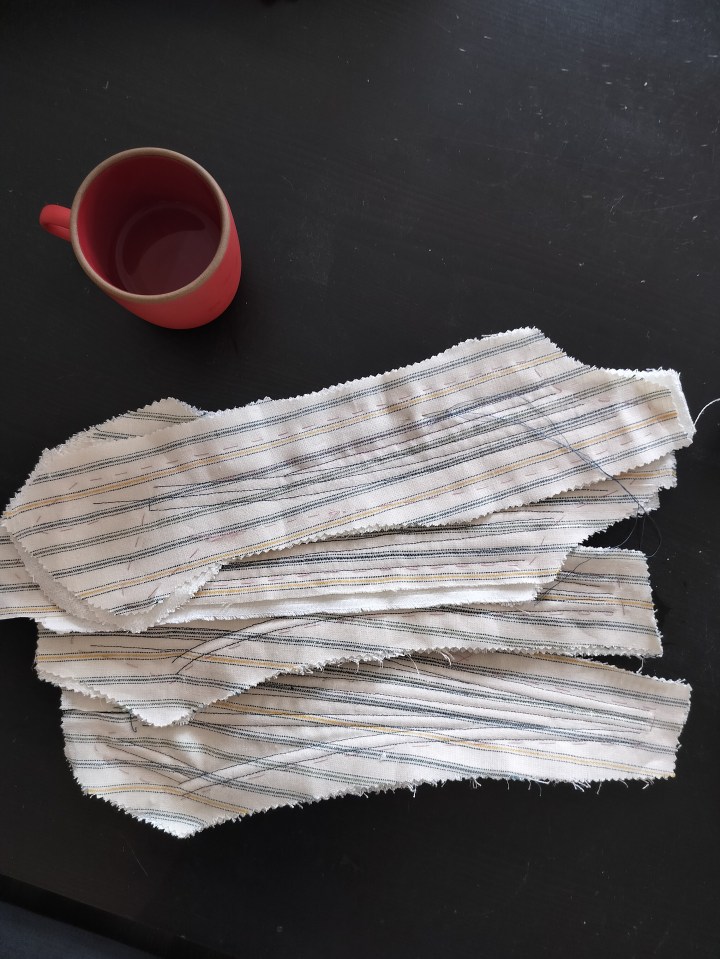
Hello! I did that thing again where I vanished! I promise I’m still making things and they are as wild and unnecessarily complicated as always.
You may know, if you’ve been around here for a bit, that I work with historic textiles professionally as well as study and recreate them for fun. Last fall I attended NATCC at Colonial Williamsburg and….fell sideways into the 18th Century.
So far, this has involved:
1. Abandoning the fully boned stays I started in 2018 figuring I didn’t know what I was doing then (fair)
2. Starting a new pair of stays
3. Going to Paris with my mom and buying a bunch of antique 18th Century or 18th Century-style textiles (remind me to post about that trip, too, it was wonderful [minus being a vegetarian who can’t eat cheese or tomatoes in France, which is challenging])
4. Convincing one of my co-workers to go to a SCA event, her finding a fabric store 15 minutes from my apartment that sells loads of 18th century-appropriate silks, and spending too much money
5. Semi-abandoning the second set of stays to make the same pattern as jumps instead because the whole thing was taking forever
anddddddd
Staring a pocket embroidery, which is where I was going with all of this.

This saga began with finding this motif on Pinterest. I absolutely fell in love– it’s a “chintz”, but it’s fantastical, I love the flower fairy and the dragon and it is so beautiful and clever and unexpected. At the time I assumed it was a modern Indian or Pakistani artist playing with this tradition of scrolling floral motifs and adding these unexpected fantasy elements. The only link attached was to an art gallery in London.
I won’t bother you with all the details of how I found out what this is (digging through the gallery website obsessively) or taking it and making something I can embroider, because the most important piece of information I found is that this is not modern. It is, in fact, from the mid-17th century in the Deccan region of India.
I love humanity. I love how historical pieces can look so modern. I didn’t love that I couldn’t find a high-resolution picture of the whole motif to copy for my pocket, but I worked around that by hand-tracing the whole thing in Autodesk Sketchbook.

and totally cheated by tracing it on water-soluble stabilizer and embroidering through that. I know, I know, 18th century embroiderers didn’t have Solvy, but they also didn’t have full-time jobs and likely had more art skills than I do. I knew I couldn’t replicate this accurately without tracing it, so even though it hurts my little nerdy heart (and I detest sewing through Solvy) I went for it.
The stitching is in three different weights of the same pale blue silk from Piper’s, and I’m stitching using a hand-forged Japanese needle that is very sharp and punctures through the stabilizer really nicely. I also take great satisfaction in carefully trimming away the extra stabilizer once an area is stitched, as you can probably tell….
Other fun things that are ongoing:
- I went to a wool festival with a co-worker and bought a beautiful BFL fleece that is slowly getting spun to use for fabric weaving
- I spent ages knitting my BFF a very un-historically-accurate hat (even though I grumbled the whole time) because he requested it. He wore it once, and then his wife accidentally ran it through the dryer and shrunk it to stuffed-animal-size. He is now getting a very historically accurate hat instead– handspun, naturally dyed Shetland wool, knit after the Mary Rose finds ala The Typical Tudor
- Victorian undergarments, for an evening gown I’ve been planning since 2019, involving tiny pintucks and Nottingham lace from the same manufacturer as Kate Middleton’s wedding dress
- My interpretation of the Eleanor de Toledo stockings, made to fit me in a naturally dyed wool/silk blend yarn
And, totally failed to document this dress I wore at Twelfth Night. Please forgive the awful photos, I had to leave it at my parent’s house when I flew back to the East Coast and therefore never got ones in a nice setting. It’s inspired by the Carpaccio exhibit I went to see at the National Gallery over Thanksgiving 2022.
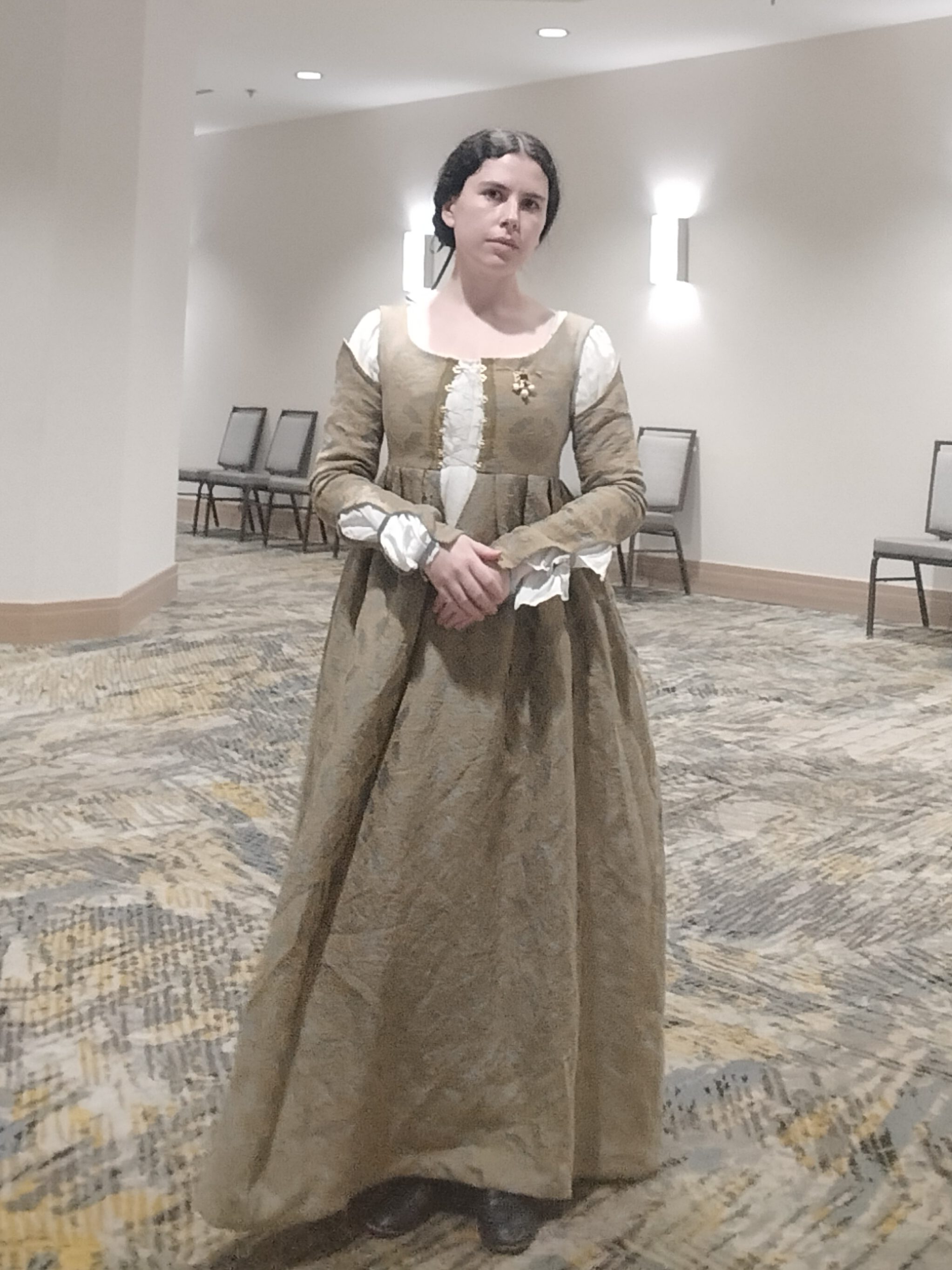
It turned out ok! At least, unlike my very fancy 1570s dress, it did not dislocate my shoulder blade. I need to retrofit that too before I continue with the outfit…..
 Not Another Costuming Blog
That embroidery pattern is so pretty! I would also have thought it was modern, I could definitely see it showing up on a modern textile.
LikeLike